Showing posts with label culture shock. Show all posts

Saturday, April 26, 2014

Culinary Catastrophes

The last few blog posts have been a bit too serious for my liking so I think it’s necessary to have a more light hearted interlude (although still a serious matter in my opinion). For those of you who know me well, you should be aware that Rachel and food have a very close relationship. I think my love of food was sparked around the same time as my love of travel. I was also blessed to have a mother who cares deeply about the environment, health, and what that means for the food we put in our bodies. I blogged about food the last time I was in Uganda because it became a HUGE source of frustration for my slightly snobby taste buds.

I do not consider myself a picky eater. I will willingly eat whatever non-meat food item appears on my plate (and even meat when I’m forced to be culturally flexible). That being said, I’ve discovered in my old age that I feel a lot better emotionally and physically when I eat quite frequent small portions of a whole-grains plant based diet with a plethora of delicious spices and flavours. I’ve also learned that I go through spicy food withdrawal if I don’t get a nearly daily dose of spiciness.

Recently a friend of mine sent me this gem of a buzzfeed list that fairly accurately describes my relationship with food (as long as the said food is healthy). This list was particularly valid when I was in my crazy running stage of life and therefore needed frequent calorie boosts to make up for all the calories I lost when I destroyed my muscles every day. Unfortunately, my food life in Uganda does not fit any of the above descriptions. I am all about adapting and attempting to be a local as much as possible. But Ugandan cuisine seriously fails to inspire or fulfill my nutritional needs. While I also find Dutch food uninspiring and bland, at least I can find anything I could want in a supermarket and most of my cultured friends will begrudgingly admit that perhaps Dutch food should not make it into any list of popular international foods.
Let me describe a typical day here:
Around 7 am: wake up make myself a hearty bowl of oatmeal/porridge (I will never get sick of this for breakfast) with some tea and fruit on the side.
Just before 8: walk to my office.
Between 9 and 10: depart for the field (depending on how efficient things are on a particular morning, but the word efficient doesn’t really exist in Ugandan vocabulary)
Between 10:30-12: Rachel starts to get a bit hungry. Ignore it knowing that it will only get worse and you won’t see food until 4 at the earliest.
1 pm: Sneakily eat a small snack (so that I don’t have a share it with the driver and my translator, evil and selfish I know).
3 pm: Yep. Starving and tired. How are the driver and intern just fiiiiine?
3:30 pm: If I haven’t given up already, conduct one more interview then insist on heading back to town (this usually involves around a one hour plus drive back).
Around 4-4:30: arrive at the one restaurant in town that still seems to have food (since they make all the food at once in the morning then run out at the end of day). Conversation with the waitress:
“Do you have beans?”
50% of the time: “They are not here.”
“Do you have gnuts?” (the only other vegetarian protein option)
50% of the time: “They are not here.” OR no response then 15 min later: “Gnuts are over.”
“Fine. I’ll have a chapatti.”
This is where I resign myself to eating the oily flatbread that offers no nutritional value.

If I’m “lucky” a bowl of beans and a huge plate of white rice awaits me. Upon its arrival I promptly ask for the chili sauce and pour half the bottle into my beans to the horror of my Ugandan co-workers. This still fails to fully give the food flavour. 

Because I am usually afflicted with low blood sugar and very grouchy during this time, talk is limited and when the conversation turns to Ugandan food and questions of whether I have tried matooke (boiled mashed bananas with zero flavour) or other local “specialities” (I had tried every single Ugandan food within about a week of my first visit since there is absolutely no variety), it is all I can do to politely respond through clenched teeth: yes I have tried matooke. It was not my favourite.

Although I’ve spent a decent amount of time in this country, it is a constant source of frustration that given how fertile the land is, Ugandans continue to “nourish” (if that is the best word considering that SO many people develop diabetes later due to the very carb based diet and love of sugar here) themselves with a startlingly limited variety of food and virtually no spices. Food wise, I can hardly wait to get back to my quinoa, greens, whole grain bread, larger variety of veggies, buckwheat, loads of bean varieties, nuts, and a pantry full of spices to satisfy my culinary creativity.


Happy first King’s day in a while to all my friends in the Netherlands! Someone go eat a nice meal for me please!  

Friday, October 5, 2012

Becoming Dutch

Subconsciously, people absorb the thoughts, attitudes, and rituals of the people around them. Of course there are deep rooted values that you learned as a child and are difficult to ever get rid of, but without realizing it you will subtly become a bit more like those you spend time with. When living outside your home country, this subconscious adaptation process is perhaps more altering. The few visits I've made to the US during the past two years of living abroad have shown me how I've changed and perhaps picked up some of the habits of the people I've spent time with in the places I've lived. However  there are certain things that haven't changed and probably never will. As I study cross cultural management I've become perhaps too aware of culture differences and how they affect interactions, and how one changes in a different cultural setting. Through this study I've discovered how "Dutch" I really am. One of the books we're studying for the class is written by Geert Hofstede, a researcher who created dimensions of culture through cross cultural surveys. He attempted to quantify culture, something I don't entirely agree with, but something that can make for some interesting discussions and comparisons when thinking about all the places I've lived over the past few years. Excuse the nerdiness of this post but below is a graph comparing the scores for the US cultural dimensions and the Dutch cultural dimensions
http://geert-hofstede.com/united-states.html

Enough nerdiness, you can read about the cultural dimensions and how surprisingly similar Dutch and American culture is (at least surprising to me since I thought the Dutch were more like Germans). Why am I Dutch?

-My (Greek) roommate and I consume an unbelievably amount of bread and cheese per week. All of the Dutch I know diligently bring their lunches to school with them. A Dutch lunch generally simply consists of bread and cheese and perhaps a bit of lunch meet. What's humorous to me is seeing my classmates bring almost a whole loaf of bread to class and happily munch on it. I also bring my own lunch to school and unlike the US where most of my friend simply ate in the cafeteria, I contentedly eat my homemade sandwich with my similar Dutch friends.

-Bringing my lunch to school brings me to point number two: my frugality. My "frugality" (there are less positive words for it) has been one constant in every place I've lived and at every stage in my life. I seem to have been born with some instinct and desire to save money at all times. I actually derive great pleasure from saving money and coming up with clever ways to cut costs. Riding around a rusty old bike that I got a good deal on (also practical since bike theft is a real problem here)? Of course! But what's lovely about this country is that all the Dutch do the same. There is no pretentiousness here. Everyone rides a bike (including the mail man--a fact that brightens my day every time I see the mail delivered) and most people have their old trusty bikes. Although, I still am probably still more frugal than the average Dutch, I don't have to explain myself to my Dutch friends when I'm trying to find the cheapest possible cell phone deal. And the expression "Dutch pay" was named Dutch for a reason. Personally, I appreciate the practicality and frugality of the Dutch. I will never understand the concept of credit and spending money you don't have.

-Sarcasm. Unlike your average German (sorry Germans), the Dutch sense of humour is actually quite sarcastic. I often find myself in situations similar to undergrad (all boys) where I am constantly being made fun of. My spelling skills are currently sub-par at best due to four years of engineering professors who were unable to spell and living in countries filled with non-native English speakers for two years. I have unfortunately made spelling errors in front of my whole class (not good when you're one of few native speakers in the class). My Dutch friends are quick to ask "which country are you from again?" and my spelling skills frequently are the topic of many jokes. It is quite pleasant to effortlessly be sarcastic without having to explain myself.

While my first month here was a bit of an adjustment coming from a country where time is meaningless, the sun shines constantly, everyone has a good sense of rhythm, and I constantly stood out, now I'm settling into the pleasantness of life in Holland. Even though the weather is predictably miserable and often causes me to nearly be blown off my bike, I am learning to deeply appreciate the orderliness of this country, the friendliness of people, the ability to find nearly anything I could possibly want in the store (and not just one store but many right next to each other! Who knew there were so many choices?), and the simply luxury of fitting in for once. Lastly, I have an unhealthy addiction to stroopwaffels. If I am obese in a few months stroopwaffels will be the cause.

Friday, May 20, 2011

Stuff Koreans Like

Prepare yourself readers (if there are any of you out there). This post is not like the others. It is hopefully offensively funny, and it features a guest author. If you have not perused the site "Stuff White People Like", I suggest wasting an afternoon and treating yourself to the humorous insights this site has to offer. This post was inspired by the exaggerated white customs that Stuff White People Like so brilliantly discusses. Before you enjoy the fruits of our labor here is the disclaimer:

DISCLAIMER:
-Neither myself or Shea Karssing (the co-author of this post) are experts on Korean culture and habits. We are merely pretending to "be an expert on your (Korean) culture" .
-Everything written here are exaggerations of our observations, experiences, and the observations and experiences of others in Korean.
-We both actually like Korea a lot. But we also like laughing at peculiarities around the world.
-If you are sensitive to generalizations and overall un-political correctness do not read this post and do not hate Shea or I.
-Please do not compare Shea and Rachel's writing (it will become painfully obvious who wrote which sections). Shea studied English and Journalism while Rachel spent four years taking notes from engineering professors who have worse spelling than the average Korean English student (but to be fair Koreans are pretty incredible at spelling).

Part I (expect future posts on this subject): Stuff Koreans Like


1. America

Who doesn't love good ol' "Uh-murrica"
No one can deny that America is the greatest country in the world, not even Koreans. Because Korea is so small obviously America must be the greatest and of course the only country better than Korea. All white English speakers (and all white people are English speakers of course) are from America.

If you are white, regardless of where you are actually from, you will frequently get stopped on the streets with “미?” (America?) and looks of awe from admiring Koreans. It’s best to just say yes and you are guaranteed new Korean friends. 

Besides making instant friends upon the realization that you are both white and American, you can expect to be treated to the wonders of American chains: Baskin Robbins (or in Korean: Baskin Lobbins), Starbucks (don't look far there's one on every corner), Dunkin Donuts, Outback Steakhouse (if you're ever craving a processed meat hamburger looking "steak-uh"), TGIF, Coldstone Creamery, even the rare Taco Bell and Subway to name a few. 

Lastly, with the large numbers of Korean Americans in America perhaps Korea is secretly plotting a plan to overrun America with Koreans so that really America will become Korea. I must say it's a clever plan and Koreans continue to dominate America's top universities and companies. See future posts for more on the relationship between Koreans and America. 

2. Obama

Koreans love Barack Obama. There are two main reasons for their love of Obama. 
1. He’s the president of America and Koreans love America. See "America". 
2. Obama is of course related to all other black people in the world so clearly he has more influence than just being president of the United States. Ask any good Korean student who Nelson Mandela is and you will discover that he is fact Obama’s father. Usian Bolt? Obama’s brother. You also might want to have a talk with your black friends about their family history because if you show pictures of these friends to any Korean student they will inform you that your friend is perhaps Obama’s cousin or aunt or uncle. Because of Obama's fame and influence he also often gets mistaken for other famous black figures. Who is Martin Luther King Jr.? Obama of course. Click here for more on this subject. 
Perhaps those skeptical of Obama's American birth
should know that Mandela is Obama's father. Maybe
 further investigation should be done into his birth
certificate after all. 

Not only is Obama president of America he is also president of Korea. Just consult the trusty English board in Bupyeong Nam elementary in Incheon, South Korea. A display proudly reads: “Our New President: Obama”. 
Ken comes to Korea

3. A thing for bling

A Korean accessories store is an epileptic experience for the magpie eye. Enter a world in which each accessory fulfils a far greater purpose than the mundane brown belt or paisley tie to which Westerners are prone. Beyonce got it all wrong: If you like it, then you gotta put a bling on it. Jewelry, cellphone danglies, shoes, waistcoats, ties, bags, suits, male undies – the blingier the better. If it has a surface, why not encrust on it some precious jewel, hand-cut in a Chinese sweat shop or mined from the depths of Taiwanese manufacturing?  Indeed, all that glitters is not gold, but who wants gold when cheap diamante catches the light so much better anyway?

4. Korean manufacturing

“Kaka jusseyo?” Cue sweet smile and fluttering eyelashes of the foreigner who conveniently speaks enough Korean so that it’s endearing when she asks for discount on some black patent shoes, but just not enough to be a valid attendee of the staff meeting that lasts for hours every Monday afternoon.
“Made In Korea!”
Nod. Smile. Batter. “Um, OK. Kaka jusseyo?
“No! No! Made in Korea! “
Endearing Discount Face relaxes back to normal. I’ll save it for the shop next door with the identical pair of Jap crap.

5. Smoking

Korean hospital patients don’t drag their drips outside for a breath of fresh 7.30am air. Rather, they use the hand not propping up their life support machines to suck periodically on white coffin nails. Oh, but only the men of course.  Aside from the fact that Korean women would never subject their printed pajama-clad selves to the scrutiny of the public eye, they’re not supposed to smoke anyway – whether outside a hospital or in the clandestine corners of a smoggy bar.  According to stats from the World Health Organisation, 67% of Korean men smoked in 2000, compared to 6.7% of Korean women (or the 6.7% who admitted to it). So for every 10 men steaming up their samgypsal and soju with ciggies in a crowded restaurant, there is one woman squatting over a toilet and dropping ash onto the seat for the next occupant to enjoy. Culturally, it is considered rude for women to smoke. But at least the men more than make up for the women’s’ poor contribution to the national smoke quota, treating the roadside jogger to a billowing faceful of Raison Red, or dusting your Vodka and Cranberry juice “cocktail” with the ash from a Vogue chick stick – a brand far too effeminate for a man hand, especially when the smoke is seeping into an accompanying sparkly tie (see “Bling”). Safe to say, Koreans may not like gays, but they most certainly enjoy their fags.  

6. Rice

In Korea, it’s not a foodstuff.  You would think each grain was a tear from God himself.  
Don't even consider skimping on the rice. 
School lunch: One of the dishes today is spaghetti. There is potato in the soup and ddeok (a kind of rice cake made with pounded rice flour) in the stew. Enough complex carbs to feed a North Korean factory for a week. I take a scant serving of the rice. Pause. Delve back into the rice cooker and dump a glutinous mountain onto my tray.  I’ll never hear the end of it if I don’t. Rice: 1; Thighs: 0.
In Korean, the word for rice is “bap”. Unsurprisingly, this word also means food or meal. In the past, the first meal of a newborn was thin rice gruel and the last thing offered to the dead was a spoon of rice.  Rice is not a food, it’s a life cycle – and apparently it’s also very descriptive: If you are struggling financially you “just manage to eat rice every day”;  losing a job means “a source of rice is gone”;  a person who doesn’t live up to expectations “doesn’t deserve the price of rice”; an angry person has “grains of rice standing on end in their stomach”;  a person who makes you upset is “the one who makes you lose your appetite for rice”; if you want to keep a secret you “do not show others the inside of the rice pot and your mind; and “did you eat rice today?” can double as a greeting. Needless to say, the idioms abound.
As do the varieties. Rice is pounded, steamed, liquefied, and glorified into noodles, milk, wine, cakes, to name but a few. Cake? Yes, “cake”.  I still have a hard time calling a brick of steamed rice flour studded with beans, peas and other unidentified bits of black “cake”. But there’s no denying  I love to eat the damn things.
It says in the Bible that “man shall not live by bread alone”. A Korean would probably proudly retort that without rice there would be no life in the first place. See “Green Tea” for further concerns. 

7. Green Tea

You may look nonchalant for now
Miss AreyouaWesternerorhaveyouhadplasticsurgery...
Yes, you may find it in a cup. But conscious consumer take heed: this green alien is taking over the world, starting in Korea. It may have humble beginnings as a harmless beverage, but today green tea is infiltrating its way into and onto human society in many ways. Deceitfully disguised as “healthy”, the sugar, flavorants, and other unpronounceable ingredients concealed by the lurid green colorants are finding their way into your ice-cream, yoghurt, shampoo, lattes, pancakes, toothpaste, cookies.
But the biggest hidden threat to mankind?  The conspiratorial collaboration of green tea and rice in the ever-popular “Green Tea with Brown Rice” (see “Rice” for more details). Koreans, they have you fooled and, frankly, it’s frightening.

8. Heels

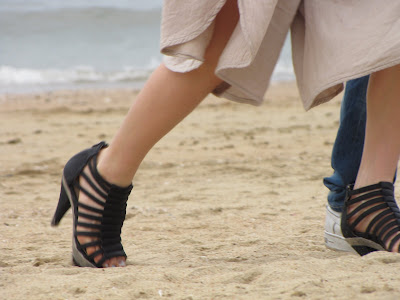
Korea probably has the highest number of heel wearers in the world as a percentage of its population. Yes, heels are considered fashionable around the world and yes they make your legs look leaner and longer but where else in the world can you find the general population sporting heels in virtually all environments, weather, and occasions?

The new beach footwear? 
Take a stroll down the street and you will spot women of all ages teetering along in heels of all varieties—sneaker heels, pointy heels, wedge heels, leopard print heels… Okay, wearing heels on a pleasant afternoon in a high fashion city like Seoul is not so strange right? Visit the beach then and you might witness a stranger sight. May is not high beach season in Korea but your average beach will still be packed with ajummas, ajoshis, children, and couples “enjoying” the beach. “Enjoying” is interpreted slightly differently in Korea. Unlike the sun worshipers of the western world, Koreans, with their brightly colored visors, and portable tents stocked with homemade kimbap; will be found protected from the sun’s relentless quest to ruin their perfect white skin. Swimming? Lying on the beach with a book? Scantily clad women (of all shapes and sizes) soaking up the sun’s deadly rays to bronze their skin? Flip-flops? Nope. But what might you spot that will cause your western eyes to take a second look? Stylish women attempting to walk in the sand in their heels. It is quite likely that you might find more women in heels than people in swimwear at a Korean beach.

While health is of the utmost importance in Korea it comes second only to appearance and fashion. Women go the physical therapist complaining of back pain. The PT’s advice? Stop wearing heels. Weeks later the women return (in their heels of course) with continued pain. In the end fashion will win over pain, or practicality.   

Thursday, February 17, 2011

Peace Corps Essay

This is an essay I submitted for my Peace Corps application and I feel like it is a fitting summary of my life in Korea. 


The title of my identification card in Korea could not be more fitting: my existence here defined by an Alien Registration Card. Living in Korea, I am reminded daily that I am an “alien” here.  In a country with a very small percentage of foreigners and an ethnically-homogenous population, there is no way to escape the fact that as a white American, I don’t even need to open my mouth to stand out. From the young Korean men in the meat department of the grocery store: “Hello! Hello! You are very beautiful!”; to the elderly Korean women openly staring at my “unusual” features or petting my hair in the subway, I am beautiful simply due to my Caucasian features. Never before have my ordinary brown hair and brown eyes caused this much commotion. Besides the obvious physical differences between the average Korean and I, I also have to adjust to cultural differences that run deeper than skin, hair and eye color. A quick bow is a standard greeting; the depth of the bow increasing depending on the authority of the person being greeted. I must remove my shoes before entering any dwelling, or swap my outdoor shoes for “indoor” shoes. Living and teaching English in Korea, it would be easy to complain about the endless list of dissimilarities between Korean and western culture.  It would be equally as simple to surround myself with foreign friends and the comforts of western food and culture. However, neither of these tactics result in the rich knowledge I can gain by taking the time to understand and adapt to Korean culture.
             To the casual foreign observer, Koreans may seem rude. They push and shove their way through the subway even when the crowds don’t seem to merit this shoving.  It is acceptable to spit at any time or place, and direct analyses of a person’s physical appearance are also the norm.  But there is also much to be learned from the gregariousness and helpfulness of Korean culture. I once asked (or rather mimed to) a random stranger for directions and instead of simply pointing out the correct route after skimming over the address, the stranger marched to a service center, studied a map, and proceeded to lead me directly to my desired location. This entire transaction was conducted through mime and limited English and Korean exchanges. While hiking, Koreans will invite my friends and I to enjoy lunch with them, immediately rush over to help us set up our tents, and offer us flashlights as we hike down a mountain in the dark.  As a whole, Koreans are the most generous, honest, and hard working group of people I have encountered. While I still find myself somewhat disgusted at the frequent globs of spit that glisten on the sidewalk, I understand that spitting in public is simply a cultural difference, rather than an act of rudeness.  I was taught that spitting in public is rude, and was told to blow my nose – a practice that is considered rude in Korean culture. Neither practice is “right” or “wrong”; it is merely a difference in upbringing. Similarly, while the habit of removing one’s shoes inside is the norm in Korea, removing shoes is a practice that varies from household to household in the U.S. Without accepting and attempting to understand these cultural differences and actively seeking to integrate myself in Korean society, I would become a poor example of a foreigner. And in a country such as Korea, I may be the only foreigner a Korean will ever meet.
             Living and working abroad is an exchange. I will learn and adapt to a different way of life and, in turn, learn and develop as a human being. In exchange, those I encounter can gain insight into my culture and country and I have the opportunity to instill a positive impression of Americans and foreigners. Taking the time and care to show that I am interested in their culture, food, and language goes a long way in bridging cultural differences and forging lifelong friendships. Building face-to-face trust, confidence and understanding in a foreign country helps connect our world in a way that distance alliances and economics ties never will and, ultimately, is a much richer experience than simply encasing myself in a little bubble of familiar faces, foods, and customs.