Friday, June 3, 2011
Getting Fancy
Once again I'm bored at work so I decided to make my blog fancy (except really it's not when you compare it to the millions of blogs floating around on the interwebs). So now in case you wonder how you too can travel, you can click on the "Travel Links" page and I have sites posted that I used to fuel my unhealthy travel addiction. So please don't tell me anymore that you are jealous of what I've been able to do. I do feel blessed for the opportunities I've had, but I WANTED this so I found a way to make it happen. Anyone can do the same.


"Teaching"
In case anyone forgot "to teach" means to impart knowledge or skill; give instruction. Being in Korea I think I often forget what it means to teach. Yes, I am theoretically an English teacher and I spend a sizable chunk of my work week "teaching", but I often wonder if what I do is actually teaching. First let me break down what a typical (although there isn't really such thing as a typical week here since my schedule seems to change without notice every two seconds) week entails.
Monday: Work from 8:40-4:40. Co-teach four classes of 6th grade in the morning (all the same lesson).
Tuesday: Co-teach four classes of 6th grade in the morning (same lesson as Monday). Teach one after school class of 1st and 2nd graders with minimal English knowledge.
Wednesday: Co-teach two classes of 6th grade (SAME lesson as Monday and Tuesday--this is where I contemplate suicide), and two of 5th grade (this is where we start to question the word "teach). Teach teachers' English (well the two teachers who show up) for approximately two hours (although this has changed every week so far).
Thursday: Co-teach three (but sometimes four or five, the schedule seems to change every single week) classes of 5th grade (same lesson as Wednesday). Teach after school 1st and 2nd grade.
Friday: Co-teach four (sometimes more sometimes less) classes of 5th grade (SAME lesson as Wednesday and Thursday--again contemplate suicide). In Konglish: pinishee (finished!). Bring on the weekend!
Now let me do a little math for you:
-There are approximately 30 students in each of my regular 5th and 6th grade classes.
30x10 classes= 300 individual 6th graders
30x9 classes= 270 individual 5th graders
20 1st and 2nd graders.
Total students= approx 600 individual students!!
-I teach the same lesson every week to my 5th and 6th graders
1x 10 classes= 10 times of pure torture (besides the first and second lessons where it's semi fun to see students reactions)
1x9 classes= 9 times of pure torture (and there is virtually no enjoyment when it comes to 5th grade)
2x 2 classes= 2 times of fun with adorable Korean children who I can do whatever I want with
Conclusion: My job can be pretty boring. There is no possible way to get to know my students because I see so many of them. 5th and 6th graders study English three times per week, they see me one time per week. Am I helping them much? Probably not.
So this all sounds a bit negative. It's not all bad, really. There are a lot of things I enjoy about teaching but the problem is what I do 80% of the time is not what I would call teaching. In a perfect world where the contract that I signed and what I learned at orientation is followed, my lessons would go something like this: My co-teachers and I would share equally the teaching and lesson planning load. My job is to be a pronunciation guide for the students and something of a novelty since I am from a different country and look different from every other person in my school. My co-teacher is supposed to be the disciplinarian, the one who teaches grammar concepts (because las a native speaker you really don't know grammar all that well), and a translator when I explain something in English. In my 6th grade classes my co-teacher and I achieve these goals relatively well. It doesn't mean that I'm still not bored out of my mind by class number ten of teaching the same lesson but I think we both still manage to have some fun in the midst of the monotony and I think most of the students enjoy themselves and don't leave the classroom hating English.
5th grade on the other hand is a different story. When teaching in Korea, you never quite know what you're going to get when it comes to co-teachers, schools, apartments, and location. I was lucky in my location, my apartment, and my main 6th grade co-teacher but of course there are things I would love to change. I am at least outwardly a patient and positive person, but "teaching" 5th grade tries even my outward patience. What are my primary duties? "Teaching" spelling (in quotations because I am NOT qualified to teach spelling therefore I don't think I'm actually imparting any knowledge to my students since I didn't have any spelling knowledge to begin with), playing games that bore me out of my mind (and I think bore my students as well), and assigning endless homework assignments that amount to essentially handwriting practice for the students. Some of the 5th graders are little devils (they know more English profanity than other vocabulary combined) yet there is little discipline in the classroom. I am the last thing from an expert teacher, but I have discovered that part of effective teaching is good classroom management and being aware of what is going on in all corners of the classroom. When a student is crying, likely because of another devil student aggravating her, in my mind something should be done.
But this is not the place for me to rant on my teaching woes. In my little dream world I am a good teacher that my students will remember for a long time, and I am actually helping my students learn some English while enjoying the learning process. This can be a difficult to impossible task in Korea. Because of private English academies that middle to upper class families send their children to, the English abilities of students in my classes can vary from kids who could carry on a pretty good conversation with me, to kids who can't read English. Managing this huge discrepancy in levels, while trying to make the required textbook material interesting and fun is only possible with a co-teacher who can effectively manage the classroom, has a fun personality and perhaps remembers what it was like to be a student. I've accepted the fact that this goal will never be accomplished with 5th grade, instead my new more achievable goals are to amuse at least one or two students in class by my ridiculous behavior (also serves the purpose of keeping me amused), and have fun with and teach (the full definition of the word) my 1st and 2nd graders.
While I may not always give instruction or impart knowledge, I can brag that I have a job where I get paid to be overly dramatic, sing, dance, sometimes shout, play, and draw. And at least I haven't quite stooped to the level of an English robot (but perhaps pretty close at times). Soon robots will replace Native Teachers in Korea so until that day I continue trying to amuse my students with my clown-like antics. See video below.
Monday: Work from 8:40-4:40. Co-teach four classes of 6th grade in the morning (all the same lesson).
Tuesday: Co-teach four classes of 6th grade in the morning (same lesson as Monday). Teach one after school class of 1st and 2nd graders with minimal English knowledge.
Wednesday: Co-teach two classes of 6th grade (SAME lesson as Monday and Tuesday--this is where I contemplate suicide), and two of 5th grade (this is where we start to question the word "teach). Teach teachers' English (well the two teachers who show up) for approximately two hours (although this has changed every week so far).
Thursday: Co-teach three (but sometimes four or five, the schedule seems to change every single week) classes of 5th grade (same lesson as Wednesday). Teach after school 1st and 2nd grade.
Friday: Co-teach four (sometimes more sometimes less) classes of 5th grade (SAME lesson as Wednesday and Thursday--again contemplate suicide). In Konglish: pinishee (finished!). Bring on the weekend!
Now let me do a little math for you:
-There are approximately 30 students in each of my regular 5th and 6th grade classes.
30x10 classes= 300 individual 6th graders
30x9 classes= 270 individual 5th graders
20 1st and 2nd graders.
Total students= approx 600 individual students!!
-I teach the same lesson every week to my 5th and 6th graders
1x 10 classes= 10 times of pure torture (besides the first and second lessons where it's semi fun to see students reactions)
1x9 classes= 9 times of pure torture (and there is virtually no enjoyment when it comes to 5th grade)
2x 2 classes= 2 times of fun with adorable Korean children who I can do whatever I want with
Conclusion: My job can be pretty boring. There is no possible way to get to know my students because I see so many of them. 5th and 6th graders study English three times per week, they see me one time per week. Am I helping them much? Probably not.
So this all sounds a bit negative. It's not all bad, really. There are a lot of things I enjoy about teaching but the problem is what I do 80% of the time is not what I would call teaching. In a perfect world where the contract that I signed and what I learned at orientation is followed, my lessons would go something like this: My co-teachers and I would share equally the teaching and lesson planning load. My job is to be a pronunciation guide for the students and something of a novelty since I am from a different country and look different from every other person in my school. My co-teacher is supposed to be the disciplinarian, the one who teaches grammar concepts (because las a native speaker you really don't know grammar all that well), and a translator when I explain something in English. In my 6th grade classes my co-teacher and I achieve these goals relatively well. It doesn't mean that I'm still not bored out of my mind by class number ten of teaching the same lesson but I think we both still manage to have some fun in the midst of the monotony and I think most of the students enjoy themselves and don't leave the classroom hating English.
 |
| This is about the enthusiasm most of my 5th graders have for English after I'm finished with them. |
But this is not the place for me to rant on my teaching woes. In my little dream world I am a good teacher that my students will remember for a long time, and I am actually helping my students learn some English while enjoying the learning process. This can be a difficult to impossible task in Korea. Because of private English academies that middle to upper class families send their children to, the English abilities of students in my classes can vary from kids who could carry on a pretty good conversation with me, to kids who can't read English. Managing this huge discrepancy in levels, while trying to make the required textbook material interesting and fun is only possible with a co-teacher who can effectively manage the classroom, has a fun personality and perhaps remembers what it was like to be a student. I've accepted the fact that this goal will never be accomplished with 5th grade, instead my new more achievable goals are to amuse at least one or two students in class by my ridiculous behavior (also serves the purpose of keeping me amused), and have fun with and teach (the full definition of the word) my 1st and 2nd graders.
While I may not always give instruction or impart knowledge, I can brag that I have a job where I get paid to be overly dramatic, sing, dance, sometimes shout, play, and draw. And at least I haven't quite stooped to the level of an English robot (but perhaps pretty close at times). Soon robots will replace Native Teachers in Korea so until that day I continue trying to amuse my students with my clown-like antics. See video below.
Thursday, May 26, 2011
I'm not the only one who loves Seoul
I promise I didn't copy CNN (I don't even like CNN that much). Check this article out on why Seoul is the world's greatest city. Here are some of my favorites if you're too lazy to read the article:
So grateful this fabulous city is my next door neighbor.
49. More side dishes than main dishes
A typical Korean meal comes with seven or eight separate side dishes. And free refills. There’s more color on a Korean table than at Lotte World on Children’s Day.
47. Best airport in the world
For five years running, Incheon International Airport, which services Seoul and other nearby Korean cities, has been ranked the best airport in the world by Airports Council International. The sprawling, über-efficient facility is equipped with a golf course, skating rink, Museum of Korean Culture, casino, high-end spa and restaurants serving just about any kind of pre-flight meal you’d want.
Go ICN! I can attest to its efficiency. Another thing I'm going to miss.27. Heated floors
At traditional Korean restaurants, tables are low and chairs are discarded in favor of embroidered cushions. Your butt may fall asleep and your limbs might seize over long lunches, but at least you won’t have to worry about a chill -- heated floors (ondol) keep buns balmy and toes toasty. They also take the sting out of traditional sleepovers, in which a plush blanket on the floor replaces a bed.
26. Bibimbap
Korea’s most recognized dish after Korean barbeque, bibimbap is rice bowl mixed with sautéed roots, marinated beef and chili paste in a hot stone pot. It was Michael Jackson’s favorite dish. It’s still the signature lunch aboard Korean Air flights. You can get it almost anywhere, including local institution Go-gung.
I'm not sure what the quality of my life will be like without this tasty dish.
25. Most art openings per square mile
Earning the attention of art aficionados worldwide, internationally renowned artists fly into Seoul almost every week for new exhibitions or collaborations. Local artists are also rising to acclaim with increasingly strange and arresting multimedia works. In Cheongdam-dong, a single building called Nature Poem -- itself a work of art -- houses 18 galleries.
And who said Koreans aren't creative?24. Superb service; random freebies, no tipping
It’s tough not to smile when your breakfast cereal comes with a free pair of socks or your latest clothing purchase bags you a designer kitchen knife. Seoulites love dishing out freebies, the more random, the better. Known simply as “service,” free gifts can be anything from a packet of Kleenex with a full tank of gas to a plate of chicken with your pitcher of Hite beer. The perfectionist jeongshin (mentality) of the service industry in Seoul ensures incredibly cheerful service. Best of all: no tipping.
YES! Probably my favorite item on the list.
20. Soju is cheaper than water
Soju martinis and soju cosmopolitans are debuting in bars overseas, but in Seoul, we prefer to drink the distilled rice (usually) beverage neat, or mixed with whiskey.
No comment.16. The kimchi miracle
When Seoul escaped relatively unscathed from the SARS outbreak a few years ago, locals credited the nation’s kimchi consumption. The spicy cabbage dish was celebrated again when scientists showed that kimchi helps prevent bird flu and Newcastle disease.
When Seoul escaped relatively unscathed from the SARS outbreak a few years ago, locals credited the nation’s kimchi consumption. The spicy cabbage dish was celebrated again when scientists showed that kimchi helps prevent bird flu and Newcastle disease.
3. World’s smartest, and cheapest, personal assistants
Haejuseyo chore services will pick up your dry-cleaning and deliver food -- and perform more difficult, personalized chores -- at the low starting fee of ₩7,000. Maybe that’s why New York’s "The Daily Beast" recently called Korea the laziest country in Asia. They got it wrong, of course. If we weren’t so busy all the time, we wouldn’t need all the extra help.
So grateful this fabulous city is my next door neighbor.
Wednesday, May 25, 2011
The Soul of Seoul
 |
| View from the roof of my apartment. But this could be any old apartment's view. |
 |
| Any street, Korea. |
Stroll down your average Korean street and you will see several things: 노래방s (Noraebang) in every building (directly translated=singing room--kind of like your own private Karaoke room), neon lights, Hyundai cars, coffee (or "copy" in Korean) shops, bars (called hofs in Korean even though "hof is technically a German word), restaurants, and love motels. At first these streets are interesting--wow so many neon lights, oh let's go to a noraebang!, mmmm look at that restaurant (nevermind that there's a nearly identical restaurant two doors down). But after a while it all starts to look the same (making finding your way around a bit difficult). Seoul is not devoid of these generic Korean streets, but Seoul has a vibe that is lacking in the other Korean cities I've visited (or at least a vibe that you have to search hard for). While, it's easy to criticize Korea and their education system for a lack of creativity there IS creativity in this country and lots of it! Introduce my favorite area in Seoul: Hongdae.

Hongdae reminds me of a cooler version of Ann Arbor, MI. Hongdae refers to the area surrounding a university famous for their art and design programs, a fact that is evident by the crowd around Hongdae. Here you can find a more off-beat, hippie crowd. Every Saturday (during warmer weather) there is a "Free Market" (but it's not really free) where local artists come to sell their work. Every week I've gone there are new treasures to be found. In addition to the market Hongdae is filled to the brim with independent coffee shops of all shapes and sizes, boutique clothing stores, art stores, and fun and unique restaurants and bars. Many foreigners are attracted to Hongdae for its buzzing night life. While Hongdae's night life is certainly fun, I think many foreigners overlook the more unique and quirky side of Hongdae. I think I could live in the Hongdae area my whole life and never visit every single cafe. Where the rest of Korea loves their department stores, and American chains, Hongdae keeps the independent shops and creativity afloat and therefore I love it.
Besides Hongdae there are several reasons Seoul has "captured my soul" (I'm sure I'm the first to come up that clever pun):
1. Mass transit
The Seoul subway system is amazing: efficient, cheap, reliable, and extremely user-friendly even for the dumbest of people (I think anyone). As I continue to look into options for next year I'm starting to panic about losing access to such reliable and affordable mass transit. The subway allows me to be completely independent. I can go virtually anywhere I want within the entire city without the expense, annoyance, and guilt of a car. Because of this luxury I'm doubtful I'll be able to bring myself to move ANYWHERE in the US for a while.
2. Constant action
I've never visited New York City (it's on my to-do list the next time I'm in the US) but I've heard that like Seoul there is never an end of things to do. I can pick a part of Seoul to visit and likely stumble upon some random outdoor performance, market, or festival. There are an endless number of groups I can join to satisfy my interests: language groups to practice German, swing dance club, volunteer groups and I've barely even scratched the service.
3. Food

One of the benefits of living in a big city of course is the availibility of a broad range of good food. I can get my Mexican fix (even if it is Midwest quality Mexican food), Indian, Japanese, "Western", Thai, Italian... Although this is the first time I've lived in a legit big city I have been spoiled to always live in semi hip college towns (with the exception of Valpo haha), meaning a fairly ready access to a variety of different cuisines. Unfortunately, this fact has spoiled my taste buds so being forced to eat bland cafeteria food in college was a difficult adjustment for me. I'm happy to have access to good food once again.
It's still funny for me to think about the Rachel of about five years ago. The Rachel of five years ago probably wouldn't be living in one of the largest cities in the world and enjoying it as much as I do. Perhaps I had done more traveling than the average American (short structured trips to Italy and Germany and Canada of course if that even counts) and my parents had certainly done way more traveling than the average American, but I was still pretty "uncultured", and clueless about a lot of things (although I still probably am). While, I haven't always lived in the "boonies" since my family has always lived in college towns, I had never really experienced a big city until moving to northwest Indiana and being a short train ride away from Chicago. I remember my first train ride to Chicago and simply being amazed at the number of people and the tall buildings. Besides Chicago northwest Indiana was culture shock in itself, moving from the hippie haven of Ann Arbor and spending my childhood in the West. But real change did not happen until traveling to Kenya on a service trip in May 2008. It rocked my perfect little world and gave me the travel bug, an incurable disease that I am still battling today ;). Then my travel rampage began: after a friend scoffed when I said I will never spend another summer in Michigan and would not return there after graduation, I set out to prove him wrong. Spring break to Haiti, two week service trip to Tanzania, summer of research in Germany and gallivanting all over Europe, spring break in Mexico, service trip to Nicaragua, volunteering on a farm in Costa Rica and now Korea. Approximately twenty four (?) countries later, I feel blessed and COMPLETELY changed from the innocent Valpo freshman five years ago. Sometimes I think I've left part of myself in each of the countries I've visited and Korea is no exception. I will miss Seoul immensely and I look forward to three more months of exploring this lively city.
 |
| Biking along the Han with free (of course) bikes |
Last word of advice: don't EVER tell me I can't or won't do something, because I have this little problem of enjoying proving people wrong and I don't like people telling me what to do. It's probably my greatest strength and fault. But it did end up getting me halfway around the world :)
Friday, May 20, 2011
Stuff Koreans Like
Prepare yourself readers (if there are any of you out there). This post is not like the others. It is hopefully offensively funny, and it features a guest author. If you have not perused the site "Stuff White People Like", I suggest wasting an afternoon and treating yourself to the humorous insights this site has to offer. This post was inspired by the exaggerated white customs that Stuff White People Like so brilliantly discusses. Before you enjoy the fruits of our labor here is the disclaimer:
DISCLAIMER:
-Neither myself or Shea Karssing (the co-author of this post) are experts on Korean culture and habits. We are merely pretending to "be an expert on your (Korean) culture" .
-Everything written here are exaggerations of our observations, experiences, and the observations and experiences of others in Korean.
-We both actually like Korea a lot. But we also like laughing at peculiarities around the world.
-If you are sensitive to generalizations and overall un-political correctness do not read this post and do not hate Shea or I.
-Please do not compare Shea and Rachel's writing (it will become painfully obvious who wrote which sections). Shea studied English and Journalism while Rachel spent four years taking notes from engineering professors who have worse spelling than the average Korean English student (but to be fair Koreans are pretty incredible at spelling).
Part I (expect future posts on this subject): Stuff Koreans Like
1. America
 |
| Who doesn't love good ol' "Uh-murrica" |
No one can deny that America is the greatest country in the world, not even Koreans. Because Korea is so small obviously America must be the greatest and of course the only country better than Korea. All white English speakers (and all white people are English speakers of course) are from America.
If you are white, regardless of where you are actually from, you will frequently get stopped on the streets with “미국?” (America?) and looks of awe from admiring Koreans. It’s best to just say yes and you are guaranteed new Korean friends.
Besides making instant friends upon the realization that you are both white and American, you can expect to be treated to the wonders of American chains: Baskin Robbins (or in Korean: Baskin Lobbins), Starbucks (don't look far there's one on every corner), Dunkin Donuts, Outback Steakhouse (if you're ever craving a processed meat hamburger looking "steak-uh"), TGIF, Coldstone Creamery, even the rare Taco Bell and Subway to name a few.
Lastly, with the large numbers of Korean Americans in America perhaps Korea is secretly plotting a plan to overrun America with Koreans so that really America will become Korea. I must say it's a clever plan and Koreans continue to dominate America's top universities and companies. See future posts for more on the relationship between Koreans and America.
2. Obama
Koreans love Barack Obama. There are two main reasons for their love of Obama.
1. He’s the president of America and Koreans love America. See "America".
2. Obama is of course related to all other black people in the world so clearly he has more influence than just being president of the United States. Ask any good Korean student who Nelson Mandela is and you will discover that he is fact Obama’s father. Usian Bolt? Obama’s brother. You also might want to have a talk with your black friends about their family history because if you show pictures of these friends to any Korean student they will inform you that your friend is perhaps Obama’s cousin or aunt or uncle. Because of Obama's fame and influence he also often gets mistaken for other famous black figures. Who is Martin Luther King Jr.? Obama of course. Click here for more on this subject.
 |
| Perhaps those skeptical of Obama's American birth should know that Mandela is Obama's father. Maybe further investigation should be done into his birth certificate after all. |
Not only is Obama president of America he is also president of Korea. Just consult the trusty English board in Bupyeong Nam elementary in Incheon, South Korea. A display proudly reads: “Our New President: Obama”.
 |
| Ken comes to Korea |
3. A thing for bling
A Korean accessories store is an epileptic experience for the magpie eye. Enter a world in which each accessory fulfils a far greater purpose than the mundane brown belt or paisley tie to which Westerners are prone. Beyonce got it all wrong: If you like it, then you gotta put a bling on it. Jewelry, cellphone danglies, shoes, waistcoats, ties, bags, suits, male undies – the blingier the better. If it has a surface, why not encrust on it some precious jewel, hand-cut in a Chinese sweat shop or mined from the depths of Taiwanese manufacturing? Indeed, all that glitters is not gold, but who wants gold when cheap diamante catches the light so much better anyway?
4. Korean manufacturing
“Kaka jusseyo?” Cue sweet smile and fluttering eyelashes of the foreigner who conveniently speaks enough Korean so that it’s endearing when she asks for discount on some black patent shoes, but just not enough to be a valid attendee of the staff meeting that lasts for hours every Monday afternoon.
“Made In Korea!”
Nod. Smile. Batter. “Um, OK. Kaka jusseyo?
“No! No! Made in Korea! “
Endearing Discount Face relaxes back to normal. I’ll save it for the shop next door with the identical pair of Jap crap.
5. Smoking
Korean hospital patients don’t drag their drips outside for a breath of fresh 7.30am air. Rather, they use the hand not propping up their life support machines to suck periodically on white coffin nails. Oh, but only the men of course. Aside from the fact that Korean women would never subject their printed pajama-clad selves to the scrutiny of the public eye, they’re not supposed to smoke anyway – whether outside a hospital or in the clandestine corners of a smoggy bar. According to stats from the World Health Organisation, 67% of Korean men smoked in 2000, compared to 6.7% of Korean women (or the 6.7% who admitted to it). So for every 10 men steaming up their samgypsal and soju with ciggies in a crowded restaurant, there is one woman squatting over a toilet and dropping ash onto the seat for the next occupant to enjoy. Culturally, it is considered rude for women to smoke. But at least the men more than make up for the women’s’ poor contribution to the national smoke quota, treating the roadside jogger to a billowing faceful of Raison Red, or dusting your Vodka and Cranberry juice “cocktail” with the ash from a Vogue chick stick – a brand far too effeminate for a man hand, especially when the smoke is seeping into an accompanying sparkly tie (see “Bling”). Safe to say, Koreans may not like gays, but they most certainly enjoy their fags.
6. Rice
In Korea, it’s not a foodstuff. You would think each grain was a tear from God himself.
 |
| Don't even consider skimping on the rice. |
School lunch: One of the dishes today is spaghetti. There is potato in the soup and ddeok (a kind of rice cake made with pounded rice flour) in the stew. Enough complex carbs to feed a North Korean factory for a week. I take a scant serving of the rice. Pause. Delve back into the rice cooker and dump a glutinous mountain onto my tray. I’ll never hear the end of it if I don’t. Rice: 1; Thighs: 0.
In Korean, the word for rice is “bap”. Unsurprisingly, this word also means food or meal. In the past, the first meal of a newborn was thin rice gruel and the last thing offered to the dead was a spoon of rice. Rice is not a food, it’s a life cycle – and apparently it’s also very descriptive: If you are struggling financially you “just manage to eat rice every day”; losing a job means “a source of rice is gone”; a person who doesn’t live up to expectations “doesn’t deserve the price of rice”; an angry person has “grains of rice standing on end in their stomach”; a person who makes you upset is “the one who makes you lose your appetite for rice”; if you want to keep a secret you “do not show others the inside of the rice pot and your mind; and “did you eat rice today?” can double as a greeting. Needless to say, the idioms abound.
As do the varieties. Rice is pounded, steamed, liquefied, and glorified into noodles, milk, wine, cakes, to name but a few. Cake? Yes, “cake”. I still have a hard time calling a brick of steamed rice flour studded with beans, peas and other unidentified bits of black “cake”. But there’s no denying I love to eat the damn things.
It says in the Bible that “man shall not live by bread alone”. A Korean would probably proudly retort that without rice there would be no life in the first place. See “Green Tea” for further concerns.
7. Green Tea
 |
| You may look nonchalant for now Miss AreyouaWesternerorhaveyouhadpl |
Yes, you may find it in a cup. But conscious consumer take heed: this green alien is taking over the world, starting in Korea. It may have humble beginnings as a harmless beverage, but today green tea is infiltrating its way into and onto human society in many ways. Deceitfully disguised as “healthy”, the sugar, flavorants, and other unpronounceable ingredients concealed by the lurid green colorants are finding their way into your ice-cream, yoghurt, shampoo, lattes, pancakes, toothpaste, cookies.
But the biggest hidden threat to mankind? The conspiratorial collaboration of green tea and rice in the ever-popular “Green Tea with Brown Rice” (see “Rice” for more details). Koreans, they have you fooled and, frankly, it’s frightening.
8. Heels
Korea probably has the highest number of heel wearers in the world as a percentage of its population. Yes, heels are considered fashionable around the world and yes they make your legs look leaner and longer but where else in the world can you find the general population sporting heels in virtually all environments, weather, and occasions?
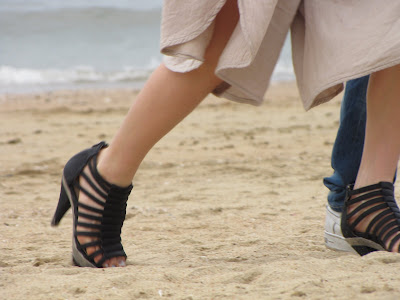 |
| The new beach footwear? |
Take a stroll down the street and you will spot women of all ages teetering along in heels of all varieties—sneaker heels, pointy heels, wedge heels, leopard print heels… Okay, wearing heels on a pleasant afternoon in a high fashion city like Seoul is not so strange right? Visit the beach then and you might witness a stranger sight. May is not high beach season in Korea but your average beach will still be packed with ajummas, ajoshis, children, and couples “enjoying” the beach. “Enjoying” is interpreted slightly differently in Korea. Unlike the sun worshipers of the western world, Koreans, with their brightly colored visors, and portable tents stocked with homemade kimbap; will be found protected from the sun’s relentless quest to ruin their perfect white skin. Swimming? Lying on the beach with a book? Scantily clad women (of all shapes and sizes) soaking up the sun’s deadly rays to bronze their skin? Flip-flops? Nope. But what might you spot that will cause your western eyes to take a second look? Stylish women attempting to walk in the sand in their heels. It is quite likely that you might find more women in heels than people in swimwear at a Korean beach.
While health is of the utmost importance in Korea it comes second only to appearance and fashion. Women go the physical therapist complaining of back pain. The PT’s advice? Stop wearing heels. Weeks later the women return (in their heels of course) with continued pain. In the end fashion will win over pain, or practicality.
Wednesday, April 27, 2011
Happiness
Two posts in one day??? Yep, this is what happens when I have no class. Just have some thoughts bouncing around in my head that I thought I'd share.
On Wednesdays, I teach teachers conversation English. It is supposed to be for all teachers in my school but the only people who show up are my main 6th grade co-teacher and the substitute 5/6th grade English teacher. Both of whom have pretty accomplished English. We have had some interesting discussions though and I use the time as a secret way of learning more about Korean culture and base my lessons around this theme.
The substitute English teacher is probably one of the most insecure, timid, dependent people I have ever met. She is very sweet, but both my co-teacher and I get frustrated with her extreme lack of independence. This woman is 36 years old (I believe) and yet sometimes I feel like I am her mother. For some reason she frequently comes to me for advice which I feel very strange giving considering the fact that she is my senior by a bit and she has been teaching for 10 years and I have been teaching a measly 8 months (besides tutoring). Anyway, yesterday before conversation class started she awkwardly and shyly asks me: "Rachel, umm.. Can I ask you a personal question?"
Immediately I got excited. When someone says the word personal I sense the potential for delightfully awkward exchanges and the discovery of interesting cultural differences/information.
Me (laughing): "Of course!"
Her: "Uh so I try to be happy everyday and rejoice always (this women is a devout Christian I think). But I'm wondering what things make you happy?" (spoken in a concerned sad tone of voice)
What? This is not the question I was expecting. Why is this woman asking me about what makes me happy? Interesting. Immediately a lot of smart remarks came to mind (I'm a bad person): 4:40 (when I leave school) makes me happy, the weekend makes me happy... But I think the joke would have been lost so I opted for a more sincere answer.
"Umm... well a lot of things make me happy. I would say I'm a fairly happy person. Family, friends, traveling, learning, running. They all make me happy. I try to focus on the good things of everyday rather than the bad because everyday comes with good and bad."
Deep I know. She seemed very impressed which concerns me because I don't want her thinking I'm some saint or something, considering the fact that in spite of my usual happy personality I am also guilty of frequent complaining. Why on earth she asked me this question I am still perplexed but it did get me to thinking.
DISCLAIMER: Here comes some semi-philosophical life nonsense. Take it with a grain of salt. I'm only 23 years old and haven't really lived life that long.
Anyway, what makes me happy? What makes me feel "tickled pink" so that I can't stop grinning? I thought about this on my run yesterday and here is the list in no particular order. I think just making this list made me happy:
-My ridiculous and hilarious family even though they're all far away
-My wonderfully unique and caring friends in every corner of the globe
-Meeting new people and discovering what they're passionate about
-Traveling (duh!)
-Being in a new place and exploring it
-Eating and especially trying new foods
-Running especially in beautiful secluded places at the crack of dawn so I can watch the sun rise
-Long bike rides
-Seeing other people happy and excited or passionate about something
-Making and giving presents
-Learning new things
-Having an "Ah ha!" moment when I find the answer to a difficult problem (generally of the math or science variety)
-Beaches
-Hiking and being in nature in general
-Sunshine especially the kind that actually radiates heat
-Mountains
-Marveling at what a beautiful and well designed world we live in
-Horses
-Teaching someone something new and seeing them get excited about it
-Avocados
-Learning new languages and getting excited when I understand something in the new language
-Trying to communicate with someone in a second language
-Art
-Creative people
-Reading
This is probably not an all comprehensive list. But here's Rachel's advice for the day: there are 400 million things that go wrong in a day, but there are also 400 million things that go right. Focus on the good things even if they're small and smile about them. I'm TRYING to do this more in Korea because there are almost always things that frustrate me here, but there are also so so many things that make me feel incredibly blessed. Complaining isn't really the most productive activity, so I'm attempting to do less of it (with limited success at the moment).
Okay, I'm done now. Too much deep philosophical nonsense for one day.
Korean Food
A post entirely devoted to the wonder that is Korean food has been long overdue and to prevent myself from blogging about things that are currently frustrating me, I will instead write about food.
Where to begin? For me, part of the joy of traveling is simply sampling different culinary treats. I love trying new and often unidentifiable foods and flavors. My mouth gets excited just thinking about it. Of all genres of food that I've tried I would put Korean food at maybe number three in the world. Mexican food gets the top spot, middle eastern/Mediterranean coming in second, and Korean coming in third. There is tough competition on my top ten world foods list because I really love so many different foods. So why does Korean food claim the number three spot?
1. Garlic
I have a bit of an obsession with garlic. As a young girl I thoroughly enjoyed helping my mom cook when using garlic cloves was involved. I readily volunteered to peel and slice the garlic because it meant I could snag a few raw garlic cloves as a snack. I was informed that eating raw garlic, while healthy, is not always pleasant for those that surround me so I eventually stopped the habit after I realized that my pores would practically start oozing garlic scent for about a day after my garlic feast. But in Korea garlic is in practically everything tasty. When you order Korean BBQ (as we call it in the States) you have the option of roasting garlic cloves with the meat and these cloves are often eaten by themselves. Yes! I can finally eat garlic without judgement. I really can't imagine food without garlic. It adds so much to almost anything. I am happy that Korea has embraced garlic wholeheartedly regardless of its more undesirable effects after eating.
2. Variety
I have lived in Korea for almost 8 months exactly now and I have barely scratched the surface of the variety of foods that exist here. I look forward to school lunch every day to see what new treat awaits me. There have been absolutely no repeats of lunch since I arrived. There is ALWAYS some new combination of soup and side dishes. A friend and I looked up a comprehensive list of Korean foods and have now made it a goal to try new things for the next four months.
3. Price
Perhaps because 99% of Koreans eat Korean food 99% of the time, Korean food is dirt cheap. I can get a filling meal for less than $4 easily and get a relatively fancy meal for less than $10. It is actually often cheaper to eat out then cook if I'm just cooking for myself.
4. Speed of service
Typical Korean dining experience: Enter restaurant and sit down (generally you choose your own table). "Yo-gi-yo" (means "come here") the waiter or waitress (basically you yell across the restaurant for someone to serve you and it is not considered rude). Order your food. Approximately one minute later standard side dishes arrive, usually some combination of kimchi, other fermented vegetables, perhaps some kind of unidentifiable seafood, Korean pancakes, etc. The best part about these side dishes is that they are unlimited. Approximately five to ten minutes after you have begun to chow down on the wonderful unlimited side dishes your meal arrives, piping hot, fresh and delicious. As an extremely impatient person who in U.S. and other countries came up with various methods of making the food SEEM like it was coming faster, Korean restaurant service is perfect in my eyes. Granted, if the food didn't come fast there would probably be a riot in the restuarant because Koreans are quite possibly the most impatient people I've ever met (even more impatient than me).
Korean food is extremely delicious but uses very few basic ingredients. I've told my Korean friends that if suddenly chili peppers, garlic, rice, and cabbage disappeared from the world, all Koreans would perish. I don't think Koreans could survive without these key ingredients. I'm a little concerned that I won't survive when Korean food is taken out of my diet in four months.
 Here are some of my favorite Korean dishes:

Bipimbap- this is a favorite among many foreigners. It is rice, a variety of cooked vegetables, usually an egg, sometimes small bits of ground meat, then mixed with a semi spicy red paste. You can also get Dolset Bipimbap which comes in a hot stone dish and everything cooks while you mix it.
Kimchi Jjigae- this is a kind of stew with Kimchi, tofu, onions, and pork. Served with rice that you can mix in with the stew. Spicy and delicious!

 Ttoekkbokki (probably a bad romanization of it)- This is made of Ddoek (thick rice noodles), fish cakes/sticks (not really sure about the translation of them), green onions, sometimes hard boiled eggs, and delicious spicy red sauce. You can find this dish on the street for around 1-2000 won! Cheap and delicious!
Kimbap- not to be confused with Sushi. While Kimbap has similar ingredients it is not sushi. If you eat it thinking it's sushi you will be disappointed. Kimbap also comes in many flavors and varieties. My favorite is tuna (chamji).
I actually have to stop writing about more foods now because it's making me hungry. While, most of Korean food is delicious they do have some strange combinations. First, Koreans have an obsession with Spam. So strange given that Koreans are also obsessed with health and think that their food is extremely healthy (I would say partially true). They put in spam in soup, in kimbap, as a side dish and also enjoy giving Spam packs as gifts. Fortunately, I haven't received a Spam pack yet. Second, Koreans enjoy these strange little hot dogs. They also put them in kimbap (no thanks!), and most recently at school I had some hot dogs with little dried anchovies. Interesting...Processed meat is not my favorite and is most certainly not healthy. Apparently during the way and post war there was an abundance of Spam from the American army and Koreans just got used to eating it that it's basically been incorporated into their cuisine now. Very strange!
Enough about food. My stomach is growling!
Where to begin? For me, part of the joy of traveling is simply sampling different culinary treats. I love trying new and often unidentifiable foods and flavors. My mouth gets excited just thinking about it. Of all genres of food that I've tried I would put Korean food at maybe number three in the world. Mexican food gets the top spot, middle eastern/Mediterranean coming in second, and Korean coming in third. There is tough competition on my top ten world foods list because I really love so many different foods. So why does Korean food claim the number three spot?
1. Garlic
I have a bit of an obsession with garlic. As a young girl I thoroughly enjoyed helping my mom cook when using garlic cloves was involved. I readily volunteered to peel and slice the garlic because it meant I could snag a few raw garlic cloves as a snack. I was informed that eating raw garlic, while healthy, is not always pleasant for those that surround me so I eventually stopped the habit after I realized that my pores would practically start oozing garlic scent for about a day after my garlic feast. But in Korea garlic is in practically everything tasty. When you order Korean BBQ (as we call it in the States) you have the option of roasting garlic cloves with the meat and these cloves are often eaten by themselves. Yes! I can finally eat garlic without judgement. I really can't imagine food without garlic. It adds so much to almost anything. I am happy that Korea has embraced garlic wholeheartedly regardless of its more undesirable effects after eating.
2. Variety
I have lived in Korea for almost 8 months exactly now and I have barely scratched the surface of the variety of foods that exist here. I look forward to school lunch every day to see what new treat awaits me. There have been absolutely no repeats of lunch since I arrived. There is ALWAYS some new combination of soup and side dishes. A friend and I looked up a comprehensive list of Korean foods and have now made it a goal to try new things for the next four months.
3. Price
Perhaps because 99% of Koreans eat Korean food 99% of the time, Korean food is dirt cheap. I can get a filling meal for less than $4 easily and get a relatively fancy meal for less than $10. It is actually often cheaper to eat out then cook if I'm just cooking for myself.
4. Speed of service
Typical Korean dining experience: Enter restaurant and sit down (generally you choose your own table). "Yo-gi-yo" (means "come here") the waiter or waitress (basically you yell across the restaurant for someone to serve you and it is not considered rude). Order your food. Approximately one minute later standard side dishes arrive, usually some combination of kimchi, other fermented vegetables, perhaps some kind of unidentifiable seafood, Korean pancakes, etc. The best part about these side dishes is that they are unlimited. Approximately five to ten minutes after you have begun to chow down on the wonderful unlimited side dishes your meal arrives, piping hot, fresh and delicious. As an extremely impatient person who in U.S. and other countries came up with various methods of making the food SEEM like it was coming faster, Korean restaurant service is perfect in my eyes. Granted, if the food didn't come fast there would probably be a riot in the restuarant because Koreans are quite possibly the most impatient people I've ever met (even more impatient than me).
Korean food is extremely delicious but uses very few basic ingredients. I've told my Korean friends that if suddenly chili peppers, garlic, rice, and cabbage disappeared from the world, all Koreans would perish. I don't think Koreans could survive without these key ingredients. I'm a little concerned that I won't survive when Korean food is taken out of my diet in four months.
Here are some of my favorite Korean dishes:Bipimbap- this is a favorite among many foreigners. It is rice, a variety of cooked vegetables, usually an egg, sometimes small bits of ground meat, then mixed with a semi spicy red paste. You can also get Dolset Bipimbap which comes in a hot stone dish and everything cooks while you mix it.
Kimchi Jjigae- this is a kind of stew with Kimchi, tofu, onions, and pork. Served with rice that you can mix in with the stew. Spicy and delicious!
Ttoekkbokki (probably a bad romanization of it)- This is made of Ddoek (thick rice noodles), fish cakes/sticks (not really sure about the translation of them), green onions, sometimes hard boiled eggs, and delicious spicy red sauce. You can find this dish on the street for around 1-2000 won! Cheap and delicious!Kimbap- not to be confused with Sushi. While Kimbap has similar ingredients it is not sushi. If you eat it thinking it's sushi you will be disappointed. Kimbap also comes in many flavors and varieties. My favorite is tuna (chamji).
I actually have to stop writing about more foods now because it's making me hungry. While, most of Korean food is delicious they do have some strange combinations. First, Koreans have an obsession with Spam. So strange given that Koreans are also obsessed with health and think that their food is extremely healthy (I would say partially true). They put in spam in soup, in kimbap, as a side dish and also enjoy giving Spam packs as gifts. Fortunately, I haven't received a Spam pack yet. Second, Koreans enjoy these strange little hot dogs. They also put them in kimbap (no thanks!), and most recently at school I had some hot dogs with little dried anchovies. Interesting...Processed meat is not my favorite and is most certainly not healthy. Apparently during the way and post war there was an abundance of Spam from the American army and Koreans just got used to eating it that it's basically been incorporated into their cuisine now. Very strange!
Enough about food. My stomach is growling!
Subscribe to:
Posts (Atom)